Nicomachos Food Graph v0.3
Food dataAI can answerwithout guessing.
NFG is an open food standard for holding dish, ingredient and allergen information as data the owner has verified. It is defined by NGraph Inc. and implemented in OMISEAI.
Nicomachos Food Graph v0.3
NFG is an open food standard for holding dish, ingredient and allergen information as data the owner has verified. It is defined by NGraph Inc. and implemented in OMISEAI.
AI fills in ingredients and allergens with plausible guesses.
In a restaurant, one wrong answer can hurt someone.
NFG keeps owner-verified information as correct data (VAD), and AI answers only from that.
We collect dish information the owner has verified and structure it, working toward a food standard AI can refer to.
AI refers to it →
We call this human-in-the-loop (HITL).
Each item has where it came from (vadSource) and how certain it is (confidenceScore 0.0–1.0).
ai_inferredAI estimateInferred from photos or text. Not used in answers; sent to the owner to checkthird_partyThird partyReviews, guidebooks and similarofficial_publishedOfficially publishedThe restaurant's site or official menuowner_verifiedOwner-verified (VAD)Correct data the owner has checked. This is what AI answers fromIngredients, cooking methods, allergens, dietary restrictions (labeling rules in 5 countries)
Taste, how to eat it, pairings and the dish's background
Structure for machines,story for people. Both carry the same source and confidence. A dish is not fully described with only one of them.
Each dish card holds only verified information and answers guests in their own language. It is in live use at restaurants in Fukui and Kanazawa.
The same dish and ingredient dictionary translates restaurant websites into English, Chinese and Korean, so wording stays consistent.
Visit omiseai.com →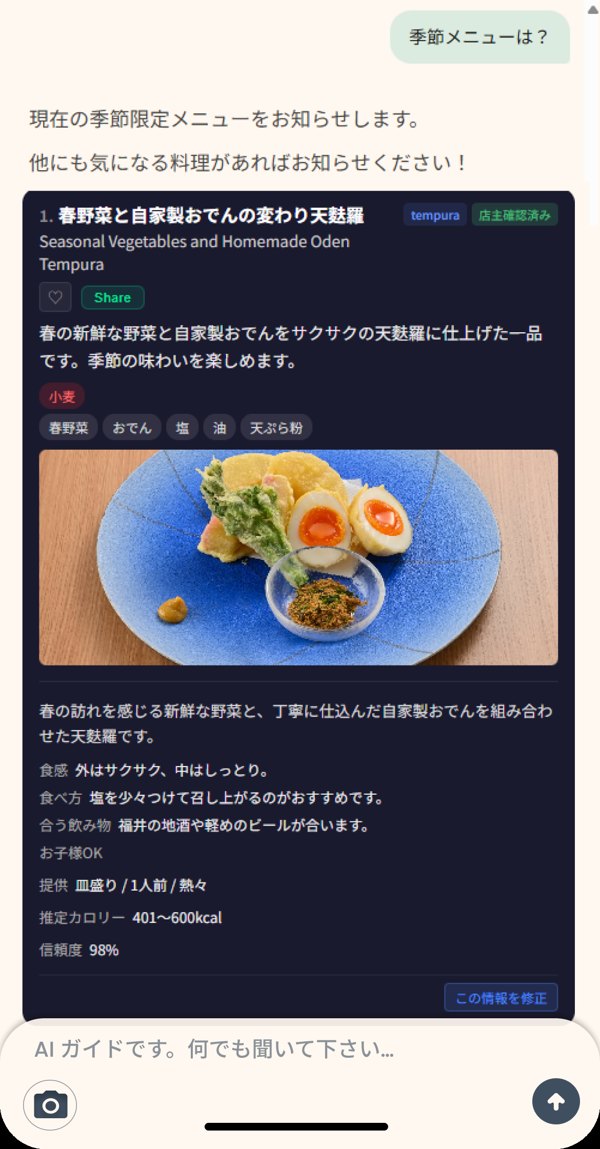
Use it as a JSON-LD vocabulary that extends schema.org.
https://nfg.ngraph.jp/schema/v0.3//schema/v0.3/context.jsonld/schema/v0.2/context.jsonld{
"@context": [
"https://schema.org",
"https://nfg.ngraph.jp/schema/v0.3/context.jsonld"
],
"@type": ["Restaurant", "nfg:SeafoodRestaurant"],
"name": "Sakanaya (fictional)",
"hasMenu": {
"@type": "Menu",
"hasMenuItem": [{
"@type": ["MenuItem", "nfg:Dish"],
"name": "Boiled snow crab",
"nfg:mainIngredients": ["snow crab"],
"nfg:scientificName": "Chionoecetes opilio",
"nfg:seasonStart": "11-06",
"nfg:seasonEnd": "03-20",
"nfg:vadCertified": true,
"nfg:vadSource": "owner_verified",
"nfg:confidenceScore": 0.95
}]
}
}nfg:SeafoodRestaurantnfg:CocktailBarnfg:KappoRestaurantnfg:KaisekiRestaurant new in v0.3nfg:Dishnfg:Ingredientnfg:vadCertifiedOwner-verified or not (boolean)nfg:vadSourceSource of verification (4 values below)nfg:confidenceScoreConfidence 0.0–1.0nfg:culturalContextCultural background for international guestsnfg:cookingMethodsCooking methods (set)nfg:dishCategoryDish categorynfg:mainIngredientsMain ingredients (set)nfg:courseFlowCourse order (ordered list)new in v0.3nfg:provenanceOrigin / sourcingnfg:scientificNameScientific name (fish, crab, etc.)nfg:habitatHabitat (e.g. 200–600 m depth)new in v0.3nfg:certificationTagOrigin or quality tag (e.g. the yellow tag on Echizen crab)new in v0.3nfg:seasonStartSeason start (MM-DD)nfg:seasonEndSeason end (MM-DD)ai_inferredthird_partyofficial_publishedowner_verifiedDuring 0.x, breaking changes increment the minor version. v0.3 adds four terms already used on live sites (KaisekiRestaurant, habitat, courseFlow, certificationTag). v0.2 remains available.
License: the vocabulary is planned to be CC BY 4.0 (not yet final).